
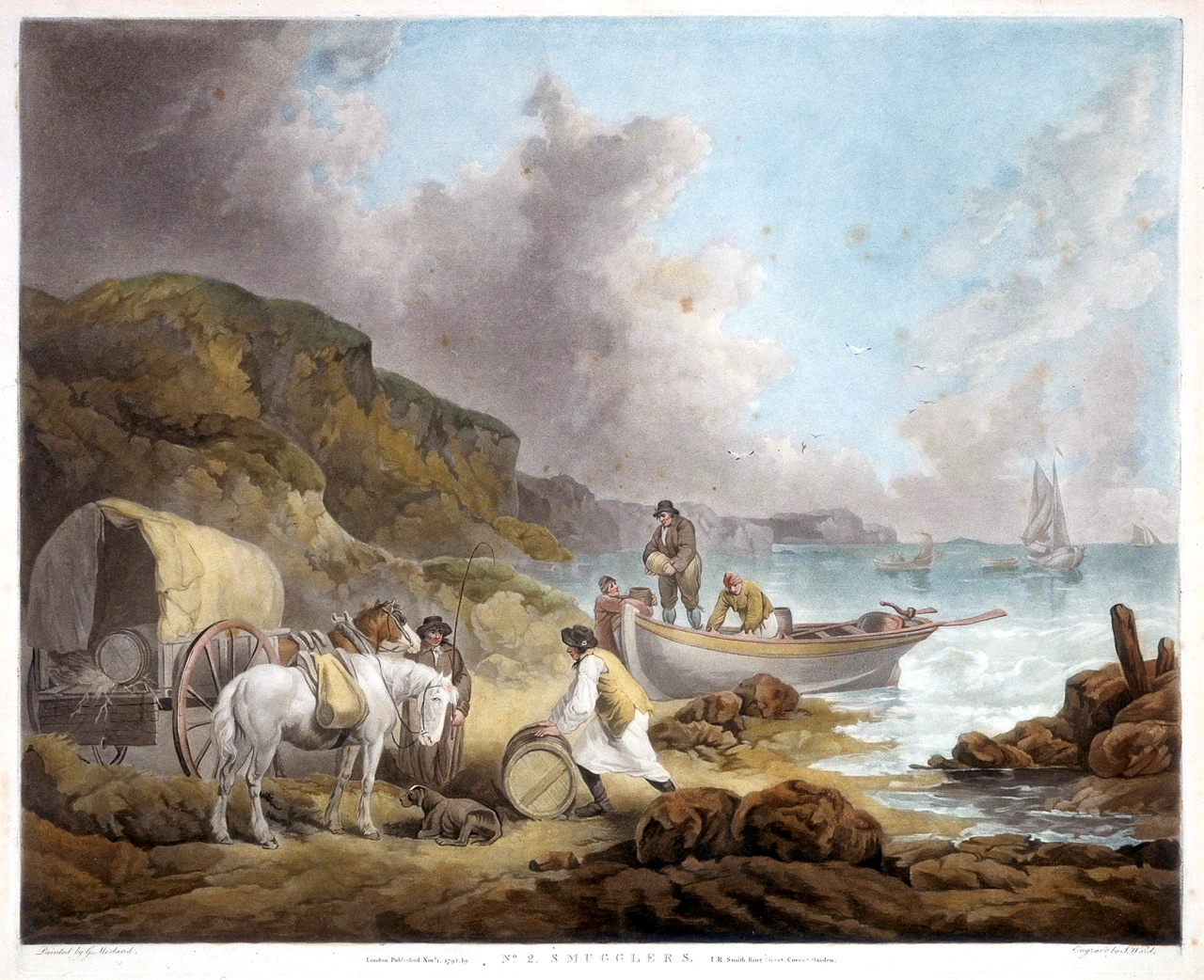
The Aldington Gang is said to have been the most prominent smuggling gang in East Kent. The Gang became known as the Blues, probably from the colour of the clothing they wore or possibly blue flares used for signalling.
It gained a notorious reputation although it was in existence for a short time. It is first recorded in November 1820, although thought to have been formed about 1817, and collapsed with the arrest of 19 members in October 1826.
The gang based itself at the Walnut Tree in Aldington and operated along the Kent Coast from Rye to Deal. Contraband from landings on the Romney Marsh was often deposited at the Walnut Tree. A light was shone from a window high up on the southern side to signal that it was safe to returning gang members on Aldington Knoll.
The gang is thought to have been led by Cephas Quested, until he was arrested in 1821.
The incident which brought the gang to the attention of the authorities occurred at Sandgate and involved 250 smugglers. A galley laden with contraband had been rowed across the channel from Boulogne and pulled up onto the shingle near Sandgate Castle.
The gang had split into three groups, one to unload and transport the goods and two as batmen protecting the first. A small number of Blockade Men spotted them but, being greatly outnumbered, chose not to intervene.
The Battle of Brookland
On 11th February 1821, at 3 am, a detachment of Blockade men encountered a party of 250 smugglers at Camber, on their way to a landing between Camber and Dungeness. Although they successfully unloaded the ship, they were chased across the marsh until the smugglers turned on the Blockade force at Brookland. Five men were killed and more than twenty wounded.
According to the statement of Charles Newton, a Master’s Mate on HMS Severn, during the battle, Cephas Quested, mistaking Newton for a member of the gang, handed him a musket and instructed him to “Shoot the ***“, referring to a Customs officer.
Quested was captured with another man. He was tried at the Old Bailey on 17th April 1821, sentenced to death and executed on 4th July 1821.
New leader
Following the arrest of Quested, George Ransley took on leadership of the Gang.
Ransley was a ploughman and a carter. It is said that he found a smugglers stash and with the proceeds of the sale bought his house, the Bourne Tap, from which he sold spirits that he landed.
The murder of Richard Morgan
On 30th July 1826 the Gang were caught on the beach at Dover. In the struggle that ensued a midshipman of the Blockade Force, Richard Morgan, was killed.
The increasing violence used by the smugglers toward both the Blockade forces and the rural communities was leading to loss of the tacit support given by those communities.
The killing of Richard Morgan led to the determination of the King’s forces to bring the gang to justice.
Demise
Six days after the murder of Richard Morgan one of the smugglers, James Bushell was captured after being injured in an exchange of musket fire at Fort Moncrief near Hythe.
On 2nd September another member of the gang was captured near Walmer Castle.
The demise of the Aldington Gang is possibly due to these captive members turning King’s Evidence. One commentator also alludes to a free member, himself dismayed by the violence being used, becoming an informant for the forces of law.
A petition for clemency was submitted in December 1826 on behalf of Edward Horn. The grounds given as:
“17 members of a large gang of smugglers and murderers have been apprehended through information given by Edward Horne (the convict and the gang’s accomplice) but he is not competent to turn King’s Evidence and testify against them because is already a convict and their trial will fail unless he is pardoned.
The gang operated for five years between Ashford Kent and the near coast perpetrating outrages and injuries against the Officers of Excise and the Navy stationed along the coast for the protection of the revenue, including the murder of Quarter Master Richard Morgan of HMS Ramillies who was shot on a beach near Dover, Kent on 30 July 1826. The King had offered a pardon under the Great Seal and the Admiralty offered a reward of £500 [for information leading to the smugglers’ or murderers’ conviction]. The smugglers’ paymaster is named as George Ransley.” 1
James Ransley was arrested at the Bourne Tap in October 1826 with seven other members of the gang.
Eventually nineteen men were arrested and tried at Maidstone assizes in January 1827.
Ransley was convicted of Morgan’s murder, but his lawyer argued that, as the incident took place in the dark, the sentence should be reduced to deportation. So he was sentenced with his brother in-law, Samuel Bailey, and gang members Thomas Gillham and James Hogben.
Ref:
- Home Office Criminal Petitions Series 1, The National Archives, HO 17/127/146.
Leave a Reply